History Vocabulary for Kids
History vocabulary covers English words children use for people, objects, events, time, and change in the past. History Vocabulary for Kids: English Words and Activities starts with concrete terms such as past, old, timeline, and museum, then introduces evidence and cause. Children need a focused word set, examples, and speaking practice. The activities help children aged 4–15 connect English with family, local, and world history without making one culture the default.
Core Words for Talking About the Past
This guide to History Vocabulary for Kids: English Words and Activities groups words by purpose. Start with time, then add people, places, objects, and actions. A few terms from each group let your child describe a picture, object, or event.
Say each word, explain it in plain English, and model a sentence. For multilingual children, a brief explanation in their strongest language supports understanding. Build the English label while respecting languages they know.
Children may see the British spelling artefact. Both artifact and artefact mean an object made or used by people. Choose one spelling for a task and teach recognition of both.
Put History Words into Context
For History Vocabulary for Kids: English Words and Activities, context matters more than copied definitions. Pair each word with a picture, action, or sentence. Instead of asking, “What does monument mean?” show one and ask, “Why might people build a monument?”
Teach connected word groups. A picture of an old settlement can introduce past, building, ruler, trade, and source. Your child can form an account: “People built homes here. Later, the settlement grew. This map is a source.”
Sequence frames help younger learners express full ideas: “First …,” “Then …,” “After that …,” and “Finally ….” Older learners can add cause: “The town changed because more people arrived.” Across LearnLink lessons with experienced tutors, tutors adjust these frames to a child’s speaking level.
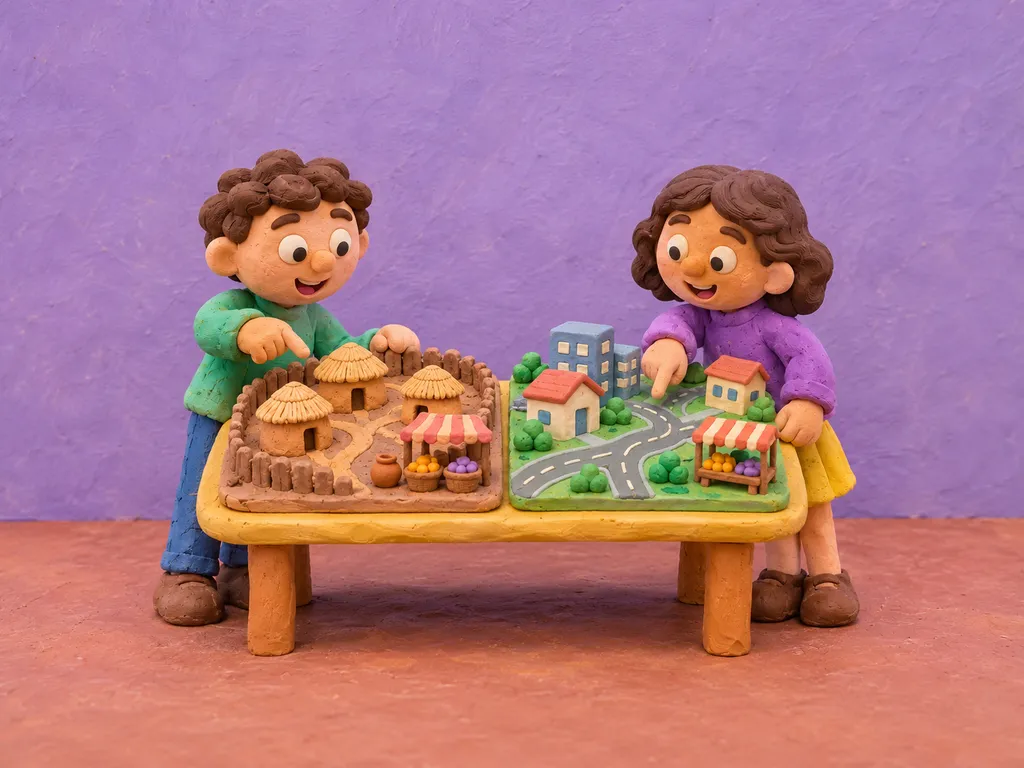
Compare two periods
Place two pictures side by side. Ask, “Which shows the past, which shows the present, and what evidence helped you decide?”
Activities for Different Ages
For school-age kids, use objects and movement. Sort pictures into past and present, build a three-picture timeline, or hide an object in a “museum box.” Ask your child to describe its shape, material, possible use, and age before explaining it.
For ages 8–10, choose a familiar subject: homes, clothes, transport, games, or a local building. Make a short timeline with five events. Your child can label it with before, after, later, and finally, then give a one-minute account.
For school-age kids, compare two short sources about the same event. Ask which details agree, which differ, and whether each statement is fact, opinion, or an unanswered question. Children practise precise vocabulary and learn to examine evidence instead of accepting each source as an answer.
Build a Short Practice Routine
When you practise History Vocabulary for Kids: English Words and Activities, keep sessions focused. Choose six to eight words, review their meanings, and use them in speech. The next day, ask your child to recall the words before showing the list.
Mix recognition with production. A child might point to the correct picture, complete “This object comes from…,” then describe it without a sentence frame. Revisit difficult words in a new setting instead of repeating one worksheet.
A weekly theme keeps practice coherent. One week might cover old toys; another could explore transport or buildings. Choose history from a region, community, or family tradition, with accurate, age-appropriate explanations.
Five-step history word check
- Choose one clear theme.
- Introduce no more than eight words.
- Model every word in a sentence.
- Ask your child to speak or write.
- Review the words on another day.
Build a Mini Timeline
Choose three changes in a familiar object, such as a phone, lamp, bicycle, or school bag. Order the pictures. Ask your child to explain them with first, later, and finally, then add one sentence using because.
Correct Common Word Mix-ups
Children may treat old, ancient, and historical as synonyms. Old is general. Ancient refers to the distant past. Historical describes something connected with history, including recent events.
Separate discover from invent. People discover something that exists or becomes known; they invent something new. Ago measures back from now, while before places one event earlier than another: “The tool was found ten years ago” but “The tool was made long before the building.”
Do not present every historical society through kings, queens, and wars. Include workers, children, traders, artists, farmers, scientists, and household objects. A broader word set makes room for histories from different cultures.
History word myths
Myth: History vocabulary is mainly a list of dates and rulers.
Fact: Children need words for time, change, daily life, objects, sources, and evidence.
Myth: A child must use English only while learning each term.
Fact: A short explanation in a stronger language can establish meaning before English practice.
- Choose two commonly confused history words and write each in one sentence.
- Read a history book aloud and pause when similar-sounding words appear.
- Create four matching cards pairing each history term with its correct meaning.
- Ask your child to explain the difference between past and passed.
- Review yesterday’s word pair by using both terms in a short story.
When a word has several meanings or pronunciations, Cambridge Dictionary is a useful check before turning it into child-friendly examples.
Frequently Asked Questions
How Many History Words Should My Child Learn at Once?
Use History Vocabulary for Kids: English Words and Activities in groups of about six to eight words. Younger children may need fewer when every term is new. Connect the words through one theme, such as transport or homes. Review them with pictures and speech before adding another group. Using five words in accurate sentences shows more learning than copying a longer list.
Can a Beginner Learn History Vocabulary in English?
Yes. Begin with visible ideas such as old, new, past, map, and tool. Use pictures, gestures, and short sentence frames. A child needs no advanced grammar to say, “This is an old map” or “People used this tool.” Introduce evidence after concrete examples establish its meaning.
Should I Correct Every Mistake During a History Activity?
Correct mistakes that change meaning, but avoid interrupting every sentence. If your child says invent instead of discover, explain the contrast because it changes the historical idea. For a small grammar slip, repeat the sentence correctly and continue. At the end, practise one or two language points again.
How Can Multilingual Children Use Their Other Languages?
Connect each English word with a word your child knows. They can make a two- or three-language label, explain an object in their strongest language, then give a shorter English account. Compare similar-looking terms carefully because meanings can differ. Existing languages support learning.
Start your child's English journey today — book a trial lesson with LearnLink.
Stay updated on our latest tips and resources by following us on Instagram LearnLink.